
How MyFoodFit works
MyFoodFit translates food label information into clear, rule-based signals. Each signal is explainable and tied to a documented rule, rather than a statistical model.
Inputs we use
- Barcode scan data, resolved across multiple verified food databases.
- Ingredient lists, allergen declarations, and additive identifiers.
- Nutrition facts per serving and per 100g where available.
- Your dietary profile, from 40 categories including allergens, medical conditions, life stage, and medication.
- Photographs of meals or nutrition labels, analysed using AI.
Consistent, rule-based scoring
Scoring considers nutrition, processing level, allergens, micronutrients, and your personal dietary needs. The same product always produces the same score for the same profile. There is no AI in the scoring engine. Products can be scored even with partial or incomplete nutrition data; confidence indicators are shown where data quality is limited.
Dietary profiles
MyFoodFit supports 40 dietary profiles across six categories:
- Goal-based: weight management, heart health, blood sugar, gut health, high protein, general health.
- Dietary: vegan, vegetarian, pescatarian, flexitarian, plant-based.
- Medical: pregnancy, IBS/FODMAP, Crohn’s/IBD, CKD, histamine intolerance, halal, kosher.
- Mental health: ADHD support, mood support.
- Life stage / medication: menopause, GLP-1/semaglutide support.
- Allergens: all 14 EU-regulated allergens.
Profiles are weighted: pregnancy boosts folate priority, menopause boosts calcium, ADHD boosts iron. The scoring system also protects whole foods, detects ultra-processed ingredients, and flags processed meat.
AI-powered features
AI handles interpretation and discovery only, not scoring.
- AI photo scanning analyses photographs of meals or nutrition labels, identifying individual items and providing personalised scores. Independently benchmarked and validated.
- AI-powered discovery powers Find Food, the natural language food discovery feature, understanding queries like “low FODMAP snack” or “heart healthy dinner”.
The architecture uses AI for photo analysis and food discovery, with specialised data integrations for barcode lookup. All scoring remains rule-based.
Explainability
Every signal includes the reason and the rule behind it. Users can see what triggered the result and where the logic comes from. There is no hidden model or black box scoring.
Decision-first food guidance
MyFoodFit is designed to answer the primary question first: "Can I eat this for my dietary needs?"
The Green / Amber / Red model provides rule-based clarity tuned to the user's primary dietary constraint. This model is a clarity tool, not a judgement system.
Explanations and nutritional details are available secondarily, so users can understand the reasoning without being overwhelmed by data before reaching a decision.
The goal is to reduce uncertainty and decision fatigue in everyday food choices.
When information is incomplete
Some food data may be missing or partial. When this occurs, the product flags uncertainty clearly and applies conservative defaults where needed.
Users are invited to contribute missing information if they choose, but this is optional. The system does not infer or assume data that is not available.
All outputs remain informational and are presented with appropriate context about data quality.
Current Beta Interface
Explainability of results
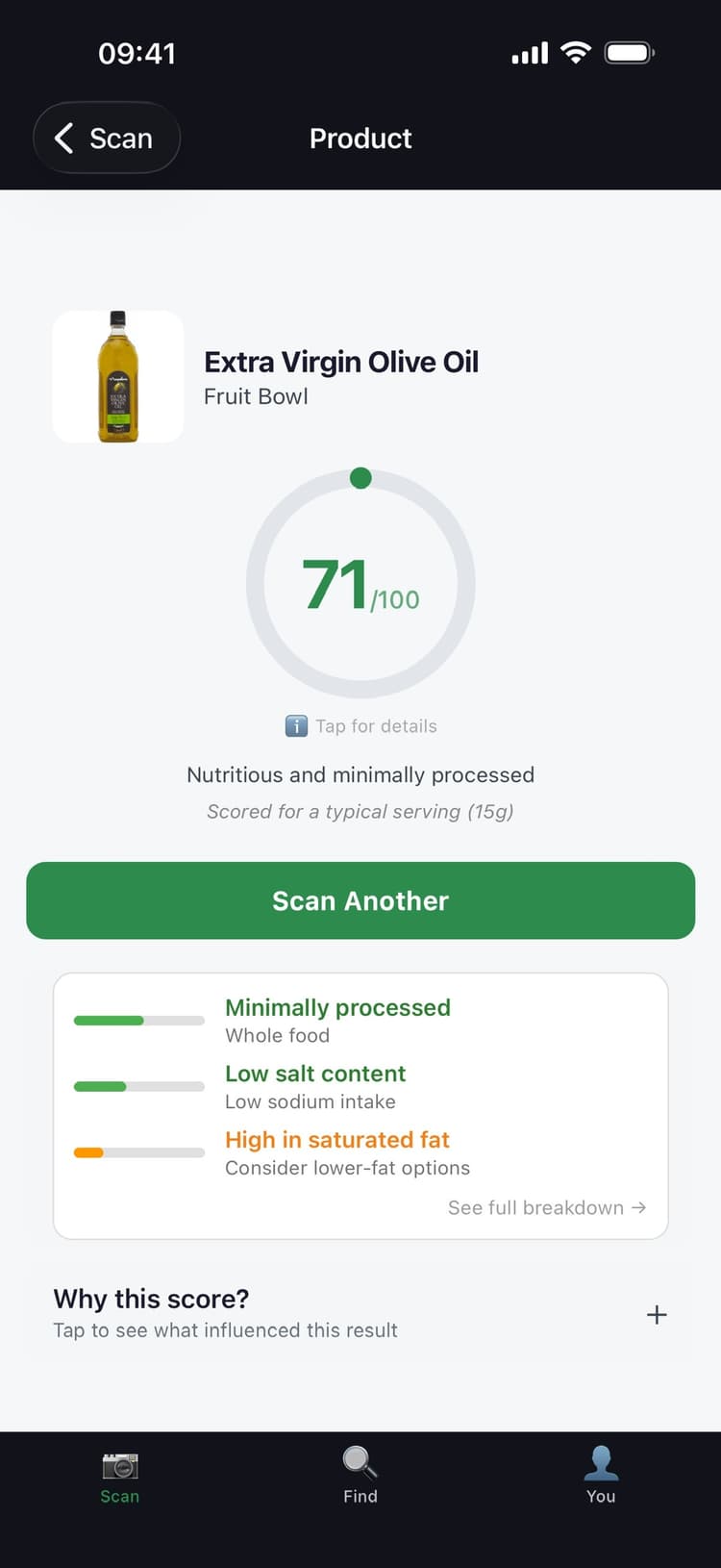
Screens shown reflect the current beta implementation and may change.
Same category, different score
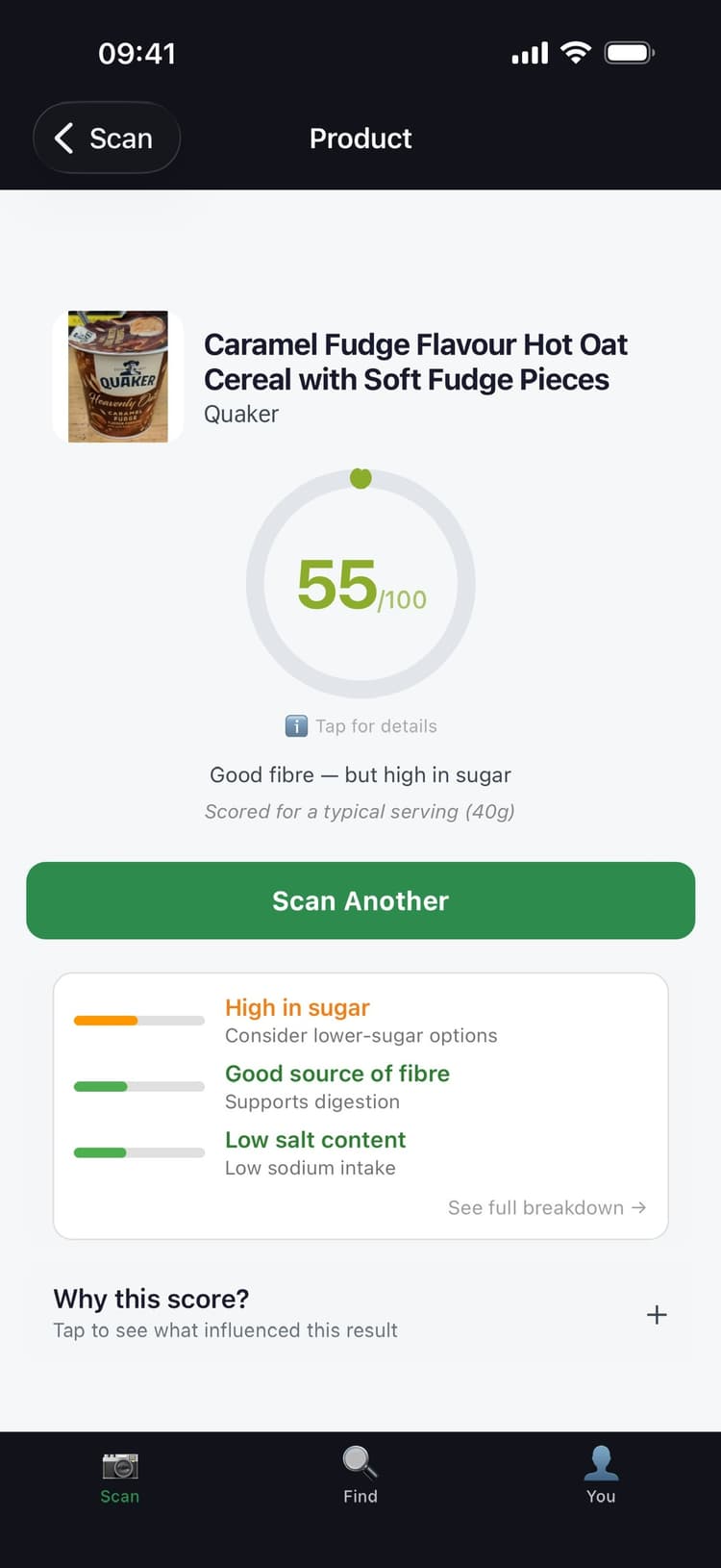
Screens shown reflect the current beta implementation and may change.
Personalised food discovery
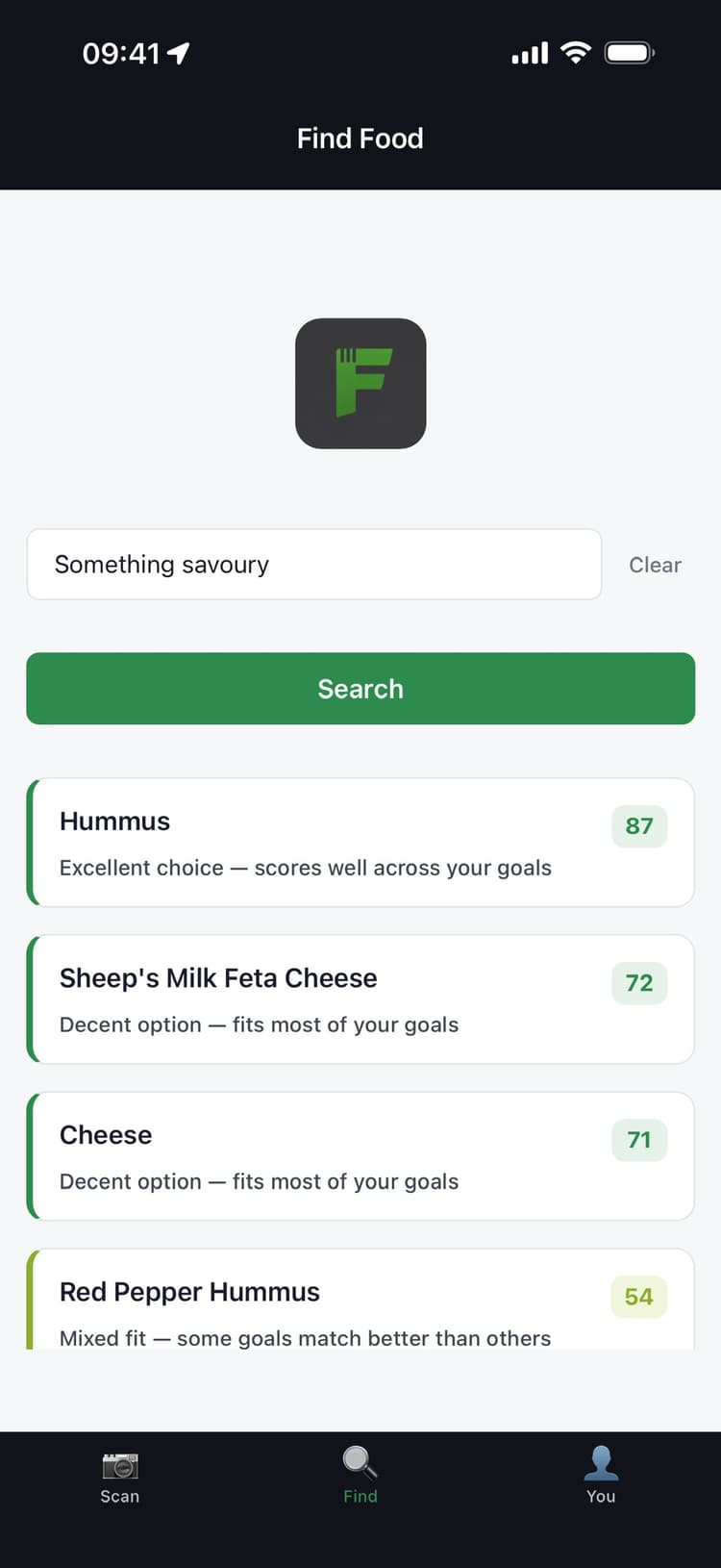
Screens shown reflect the current beta implementation and may change.
Limitations
- Food labels can be incomplete or inconsistent; outputs are only as reliable as the underlying product data.
- Scoring reflects your stated dietary profile, not a clinical assessment of your individual health. For specific health conditions, consult a healthcare professional.
- The rule set is evolving and may change as we incorporate feedback and external review.
MyFoodFit provides educational information and does not provide medical advice, diagnosis, or treatment.